

The System of Record for Meeting Driven Execution
UMS governs meetings, decisions, actions, risks, and accountability across the enterprise, turning conversations into controlled execution.
Meeting intelligence | Execution governance | Enterprise-grade control


What UMS Governs Across the Organization
UMS governs the complete lifecycle of meetings and all execution artifacts that emerge from them, ensuring traceability, ownership, and closure.

Meetings (as Governed Entities)
Meetings are treated as persistent organizational records and not disposable calendar events.
Decisions
Formal decisions captured with context, ownership, and downstream impact.
Action Items
Executable commitments with owners, due dates, and closure tracking.
Issues
Open operational or governance concerns requiring resolution or escalation.
Risks
Identified risks with visibility, ownership, and mitigation tracking.
Recurring Obligations
Periodic reviews, compliance checkpoints, and standing commitments tied to meetings.
Minutes of Meeting (MoM)
Structured, auditable meeting records linked to decisions and actions.
Meetings as Governed Organizational Records
In UMS, meetings are treated as persistent organizational records with a defined governance lifecycle, not as disposable calendar events. Each stage exists to ensure clarity, accountability, and controlled execution.
Meeting Lifecycle Stages
Stage 1 - Draft

The meeting record is created with purpose, scope, and initial context.
-
Agenda defined
-
Expected outcomes identified
-
Participants and roles outlined
No execution occurs at this stage—intent and structure are established.
Stage 2 - Scheduled

The meeting is formally scheduled and becomes an accountable organizational event.
-
Time, participants, and cadence confirmed
-
Pre-reads and references attached
-
Governance visibility established
Stage 3 - Conducted

The meeting takes place and outcomes are captured in real time or post-session.
-
Discussions recorded
-
Decisions, actions, risks, and issues identified
-
Accountability begins
Stage 4 - Reviewed
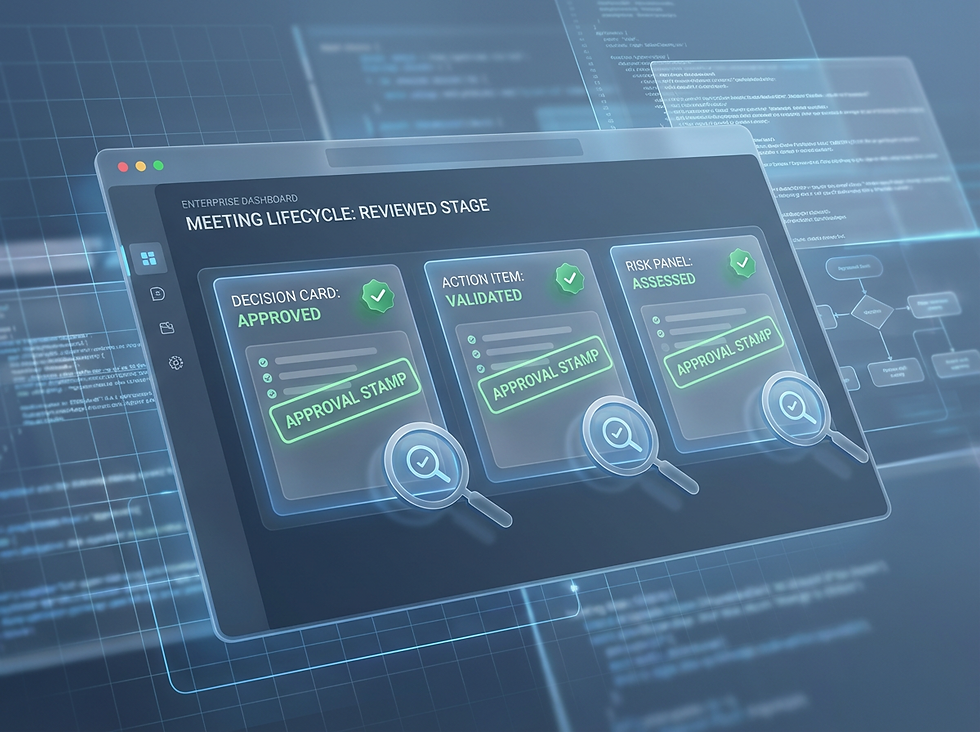
Captured outcomes are validated for accuracy and completeness.
-
Decisions confirmed
-
Action items verified
-
Risks and issues assessed
This prevents informal or ambiguous outcomes from entering the governed record.
Stage 5 - Published

The meeting record is finalized and made authoritative.
-
Minutes of Meeting (MoM) finalized
-
Outcomes formally communicated
-
Downstream systems or stakeholders informed
Stage 6 - Closed

The meeting is closed only when governance conditions are met.
-
All required outcomes are owned
-
Execution tracking is initiated
-
Audit and traceability preserved
In addition to standard lifecycle stages, UMS supports controlled exception states to handle real-world changes without breaking governance continuity.
Governance-Controlled Exceptions
Rescheduled
Timing changes without loss of governance or context

Cancelled
Meeting intent preserved with documented rationale

Deferred
Temporarily paused under governance control
Meetings are closed only when governance and execution conditions are satisfied, not when the calendar time ends
From Discussion to Ownership to Closure
Meetings generate decisions and commitments. UMS ensures those outcomes do not disappear after the meeting ends.
UMS establishes a governed execution chain that connects discussions to decisions, decisions to actions, and actions to accountable closure, while preserving visibility and traceability across the organization.
How Execution & Accountability Work in UMS
Persistent Outcome Linkage
Decisions, action items, risks, and issues remain persistently linked to the meetings where they originated, preserving context, intent, and historical traceability.
Clear Ownership Assignment
Every governed outcome is explicitly assigned an owner, ensuring accountability is established at the moment outcomes are created—not after follow-ups.
Status Visibility & Tracking
Outcome status is tracked across its lifecycle, enabling leadership and stakeholders to see progress, delays, and dependencies without relying on informal updates.
Governed Escalation
Unresolved or overdue outcomes are surfaced through governed escalation, ensuring issues receive appropriate attention without silent neglect or loss of accountability.
Governing Principle
Execution is not optional, informal, or disconnected, outcomes remain governed until they are resolved or formally closed.
Role-Aware Visibility Across the Organization
UMS provides role-aware visibility that delivers the right level of insight to each layer of the organization without overwhelming leaders with operational details or fragmenting accountability.
Visibility in UMS scales upward through governance, not volume.
How Visibility Works in UMS
Executive Oversight
Executives receive high-level visibility into decisions, risks, issues, and execution status across the organization without being drawn into task-level detail. This enables informed oversight, early risk awareness, and governance assurance without micromanagement.
Manager Accountability
Managers gain visibility into owned outcomes, team commitments, and execution progress, allowing them to actively manage accountability, resolve blockers, and ensure timely closure. Visibility supports intervention where needed—without duplicating operational effort.
Team Execution
Teams see the actions, decisions, and responsibilities directly assigned to them, along with relevant context from the meetings where they originated. This ensures clarity, focus, and execution without ambiguity or information overload.
Governing Principle
Visibility scales upward without pulling leaders into operational detail.
Measuring What Meetings Produce
Meetings consume significant organizational time and attention. UMS enables organizations to understand what meetings produce, by analyzing outcomes, execution patterns, and governance signals across the enterprise.
Insights are derived from governed records, not subjective reporting.
How Analytics & Insight Work in UMS
Meeting Effectiveness
UMS enables organizations to assess how meetings translate into decisions, actions, and outcomes highlighting which meetings drive execution and which consistently underperform. This supports better meeting design, preparation, and governance over time.
Execution Follow-Through
Execution patterns across decisions and action items reveal how reliably outcomes move toward closure after meetings conclude. This allows leadership to identify strengths and gaps in follow-through without relying on anecdotal updates.
Bottleneck Identification
UMS surfaces where decisions, actions, or issues routinely stall, whether due to unclear ownership, cross-team dependencies, or governance friction. These insights help organizations remove systemic blockers rather than treating delays as isolated incidents.
Risk & Issue Patterns
Recurring risks and unresolved issues can be analyzed across meetings, teams, and time periods to reveal emerging patterns and governance weaknesses. This enables earlier intervention and stronger institutional risk awareness.
Governing Principle
UMS focuses on governed outcomes and execution patterns, not surveillance of individual activity.
See UMS in Action